Next.js SaaS boilerplate
See how the App Router, accounts, admin surfaces and production controls form one typed application.
Launch your SaaS with auth, billing, teams and AI already wired. Choose Supabase or Neon, your payment provider, and build with Claude Code, Codex or Cursor.
❯ git clone https://github.com/boilerplate-stack/boilerplate-stack-prod
✓Cloning into 'boilerplate-stack-prod'... done.
❯ cd boilerplate-stack-prod && pnpm install --frozen-lockfile
✓Packages: +982 · signatures verified · 0 vulnerabilities
✓Done in 11.4s
❯ pnpm run init
✓Branding, business model & admin email configured
✓Database, auth, payments, storage & email providers selected
✓Prisma schema initialized · .env.local + config/app.ts generated
❯ pnpm dev
✓▲ Next.js 16.3.0 ready on http://localhost:3777
❯ claude "add a chat agent that answers from our docs"
✓Matched skill: /create-ai-agent · loaded config/ai.ts
✓Read rules: api.md · database.md · CLAUDE.md
✓Created agent · RAG pipeline · credit deduction wired
✓Types pass · ESLint clean · 0 questions asked
▸Shipped in 18s · agent live in chat selector
Built on the stack you already trust
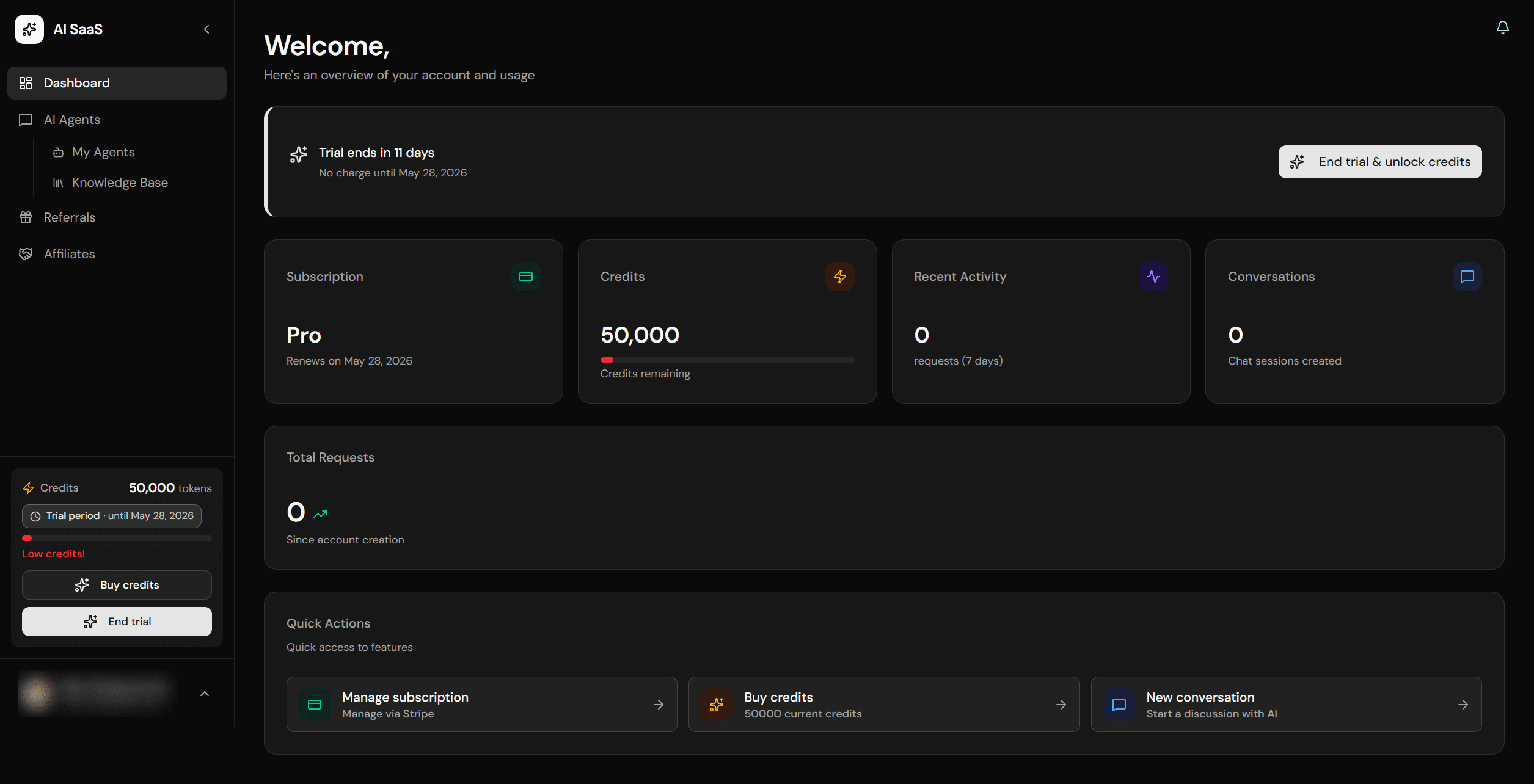
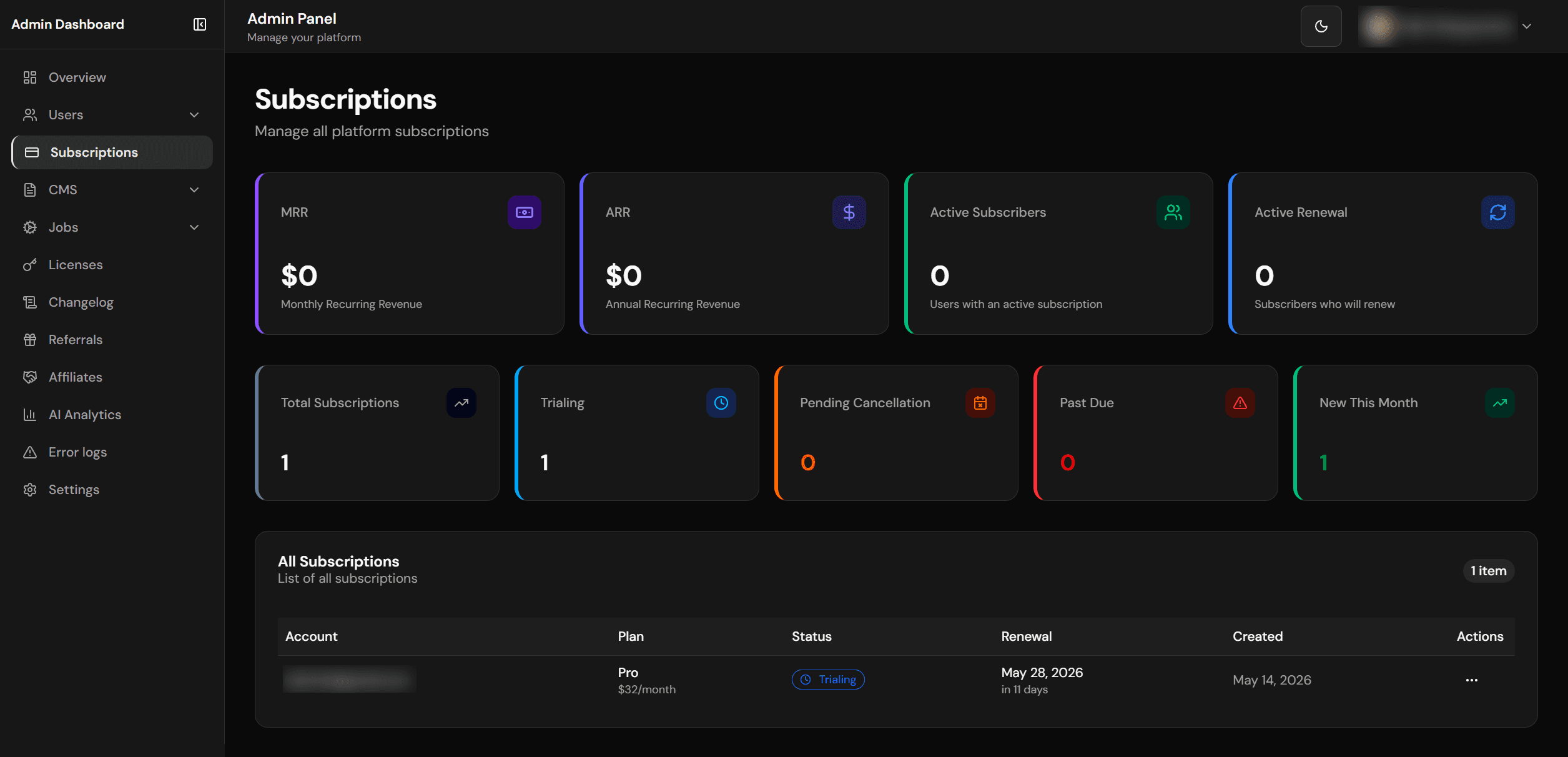
Fully built, responsive screens for provider-neutral admin, billing, AI, analytics and CMS workflows — ready to ship today.
Users, Accounts, subscriptions, CMS, media, scheduled jobs, operational health and consent-aware product analytics — all built on provider-neutral repositories.
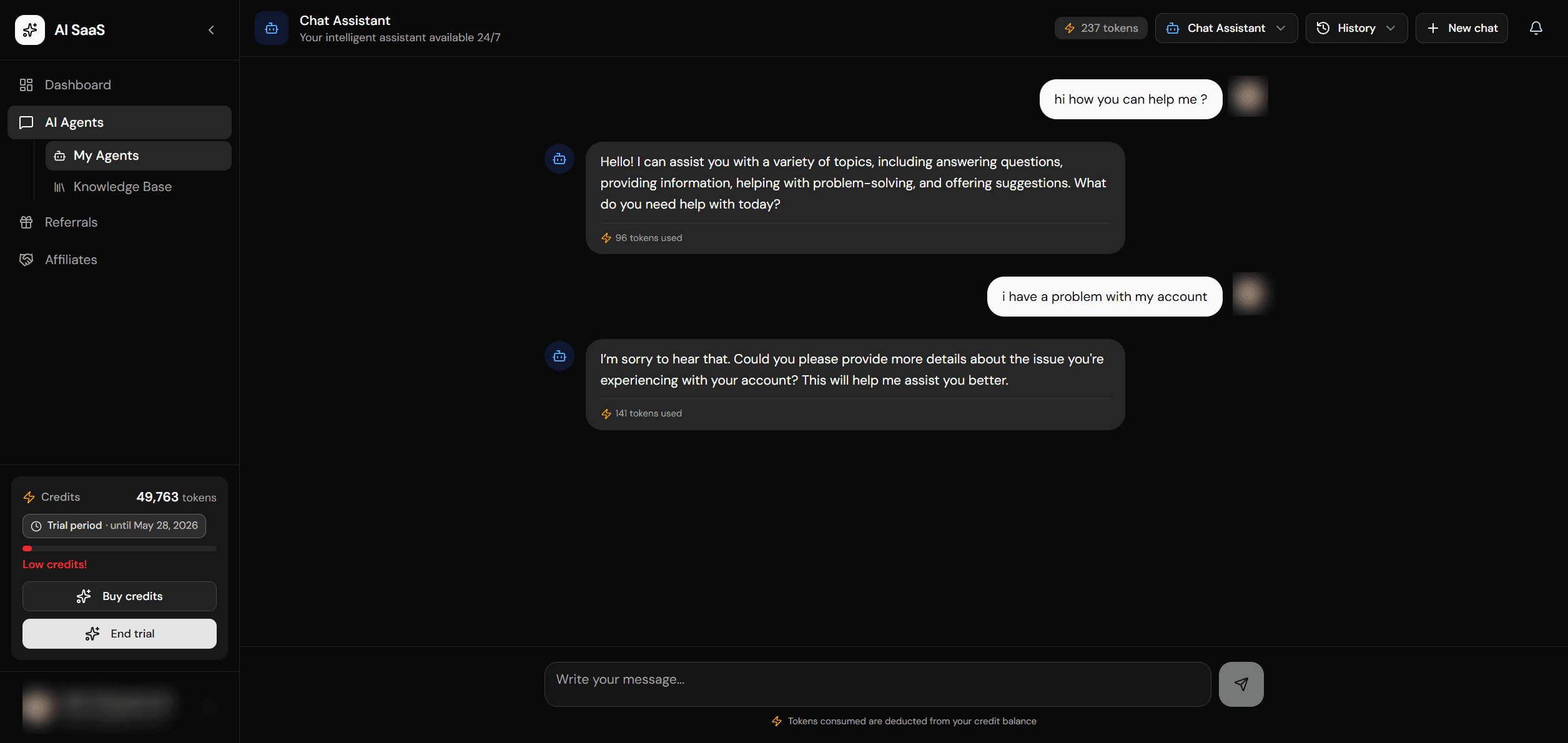
A quick tour of what ships in the box — admin, billing, AI and the agent workspace.
Months of foundational engineering — done, typed, documented and ready to extend.
GPT-5.6, Claude Opus 5 and Gemini 3.6 behind one server-only LLM boundary, with Account and member allowances, model and agent policies, output limits, threshold alerts and exact provider-token accounting. B2B adds an organization-managed, Account-scoped knowledge base for every member; B2C keeps personal libraries. Includes resilient streaming, safe PDF ingestion, cross-provider failover and pgvector + HNSW search.
View documentationEnrolled MFA is enforced across authenticated APIs, independently from recent-factor step-up for sensitive actions. Organization coverage, remote session revocation, OWASP-aligned CSP, configurable rate limiting, RLS, CSRF and Turnstile pair with fail-closed provider checks.
View documentationArticle 50 transparency implemented, not just documented: AI-interaction notice, durable output marking, a public transparency page — and the operator paperwork as templates (Art. 30 ROPA, Art. 35 DPIA, breach runbook, DPA register). Plus an Art. 15 export in 28 sections and an append-only consent trail.
View documentationNext.js 16.3, React 19, Node 24 LTS and shared Prisma/PostgreSQL repositories across Supabase or Neon. Strict TypeScript, Tailwind v4, shadcn/ui, Docker + Coolify, SEO, PWA and a guided initializer keep every supported provider composition explicit.
View documentationChoose the identity provider during setup while keeping one canonical application identity. OAuth, magic links, passkeys, enforced TOTP MFA, recovery codes, real device sessions, onboarding and GDPR-compliant account deletion share the same product contracts. Better Auth verification reservations are replay-safe, and invalid-code feedback is reserved for explicit OTP rejection.
View documentationChoose one payment provider for subscriptions, one-time products, licences, credit packs, multi-currency, webhooks, refunds and admin reporting. Durable signed payment proofs, Account-safe entitlements, guest checkout and affiliate flows are already wired.
View documentationB2C personal accounts or B2B workspaces with dynamic roles, permissions, invitations and account switching.
View documentationMulti-locale CMS, media and documents work with Supabase Storage, Neon Object Storage, AWS S3 or storage disabled. Dedicated pg_cron workers publish heartbeats; the protected dashboard surfaces queue age, terminal failures, mandatory-job health and notification dead letters. Push and in-app delivery use independent durable outboxes.
View documentationURL-based locales (FR/EN), auto-detection, localized components and a pluggable email layer (Brevo, Mailjet).
View documentationOne hue token drives every brand, neutral and chart colour, so a rebrand is one line. Pattern library, manifest-driven navigation, Motion, and contrast measured rather than eyeballed.
View documentationDisposable-database gates seed member, admin, owner and platform-admin personas and prove auth, billing, analytics, AI policies, chat/RAG and documents end to end. Database assertions, Playwright journeys, WCAG 2.2 A/AA, responsive coverage, browser matrices, visual baselines and route-level JavaScript and Lighthouse budgets protect every release.
View documentationEvery item below is implemented in the codebase, not a roadmap.
Search by stack or product capability, then see how each part is implemented and connected to the rest of the codebase.
See how the App Router, accounts, admin surfaces and production controls form one typed application.
Explore subscriptions, licences, credits, guest checkout, webhooks and account-scoped entitlements.
Review the Auth, Postgres, Storage, membership and Row Level Security boundary.
Inspect multi-LLM chat, agents, RAG, credits and the repository context used by AI coding tools.
Drop a generic starter into Claude Code and it guesses. Drop in Boilerplate-Stack and it already knows the architecture, the conventions and the patterns.
// agent without context
@@ agent with full context
A first-class .claude/ workspace ships in the box. Your agent reads it and immediately works like a senior dev who has been on the team for months.
❯/create-api-endpoint secure, rate-limited route + Zod
❯/stripe-webhook verified Stripe webhook handler
❯/add-translation sync FR + EN locale files
❯@db-architect audit queries for N+1
Works with Claude Code, OpenAI Codex and Cursor.
Slash commands that generate code in your exact conventions.
/create-api-endpointExpert reviewers that audit security, queries and payments.
@security-reviewerLint, type-check and protect sensitive files on every edit.
lint + typecheck on editModular domain rules loaded on demand, per area of the codebase.
database.md · billing.mdThis isn't a boilerplate you read — it's one your agent operates. The .claude/, AGENTS.md and .cursor/rules/ configs ship in the box, so any AI coding tool understands the codebase from the very first prompt.
Grab the repo and install. The full agent workspace — rules, skills, subagents and hooks — comes with the code.
❯git clone … && pnpm installOpen the folder in Claude Code, Cursor or Codex. The agent loads your conventions automatically — zero setup, zero priming.
❯claudeDescribe the feature. The agent writes code that already respects your auth, billing, RLS and i18n patterns — on-pattern, not guessed.
❯add a team invites pageShip a chat assistant in the EU and Article 50 binds you. It is implemented here — and the operator paperwork comes with it.
Article 50 of Regulation (EU) 2024/1689 has applied since 2 August 2026 and was explicitly excluded from the Digital Omnibus deferral. Ceiling: EUR 15,000,000 or 3% of worldwide turnover.
Obligations any product interacting directly with natural persons has to meet.
Implemented in the codebase and verified at runtime, not described in a README.
Editable documents, pre-filled for a stock deployment.
Eight processing activities with legal bases, recipients and retention.
Six risks analysed, residual ratings and the pre-launch mitigations.
Hour-by-hour procedure, plus the SQL that answers the regulator's scoping questions.
Subprocessor register and the customer-DPA clauses this stack can meet.
Deadlines, Annex III self-assessment, env vars and a verification query.
The implementation is done. Classifying your own product's risk tier stays your call — the config makes it explicit instead of assuming it. Direct-provider ZDR stays an account and DPA control on your side: the code sets store: false and the SDK flag, it cannot sign your contract.
Every brand, neutral, sidebar and chart colour derives from a single hue token. Drag it and watch a dashboard change identity — no stylesheet sweep, no find-and-replace.
:root {
  --brand-h: 288;
}Tone sits on fills and icons here, every label stays on a foreground token — which is exactly why no hue on this slider can break contrast.
What it costs to build this foundation yourself — versus owning it this afternoon.
No seats. No subscription. No usage metering. Buy it, clone the private repo, ship forever.
For indie hackers & solo developers
For small teams & startups
For agencies & multiple projects
Everything worth knowing before you buy.
Instant access to a private GitHub repository with the complete, production-ready Next.js 16 source code: Supabase auth, multi-currency Stripe billing, multi-LLM AI with RAG, B2C/B2B multi-tenancy, CMS, scheduled jobs and OWASP-aligned security — plus the .claude/ AI workspace.
Next.js 16.3 App Router, React 19, strict TypeScript, Node 24 LTS, pnpm workspaces, Supabase (Postgres + Auth + Storage + RLS), Stripe, LangChain, Tailwind CSS v4, shadcn/ui, Motion, URL-based i18n (FR/EN), Docker & Coolify ready.
It ships with a complete .claude/ workspace: CLAUDE.md, modular domain rules, custom slash-command skills, specialized subagents and quality hooks. Claude Code, Codex and Cursor read it and generate code that follows the project's conventions from the first prompt.
Every chat and embedding request crosses one server-only LlmClient — the only module allowed to construct a provider SDK or call an inference endpoint. You pick the transport with AI_LLM_TRANSPORT: the direct OpenAI, Anthropic and Google APIs, or OpenRouter. On the gateway, requests require ZDR-capable endpoints, deny provider data collection and never fall back to an ineligible provider; Claude Fable 5 is kept out of the catalogue on purpose, because Anthropic documents a mandatory 30-day retention for it. Direct calls set store: false and the SDK ZDR flag — contractual zero retention with a direct provider remains an account and DPA matter on your side, which the operator docs state plainly instead of implying the code covers it. Audit rows record the resolved model, route and upstream request id; prompts, responses and provider bodies are never written to them.
The Article 50 transparency obligations are implemented, not just documented: the AI-interaction notice renders on every chat surface, AI output is marked durably in the database and on the response headers, and a public /ai-transparency notice lists the providers that actually receive prompts. You also get the operator paperwork as editable templates — Article 30 records of processing, an Article 35 DPIA scaffold, an Article 33/34 breach runbook, and a subprocessor + DPA register. Article 50 has applied since 2 August 2026 and was excluded from the Digital Omnibus deferral. The risk classification of your own product remains your call — the config makes it explicit rather than assumed.
pnpm only, one lockfile, an integrity-pinned package manager and a Node 24 LTS baseline shared by CI and Docker. Dependency lifecycle scripts are off by default with a reviewed allowlist, new releases sit in a seven-day quarantine before they can be resolved, package signatures are re-verified at install, and CI runs a frozen install plus a low-or-higher audit before any code check. The audit baseline is zero — a low advisory fails the build rather than filing a ticket.
Yes. Solo covers 1 project, Team up to 3, Agency unlimited. Freelancers and agencies ship client SaaS products on it.
You get the private repo with updates for your tier's window (Solo 12 months, Agency 2 years). Any code you've already pulled is yours to keep regardless.
Because you receive the full source code and private repo access immediately, all sales are final — no refunds once access is delivered. Review the live demo and the documentation first so you can buy with full confidence.
Yes. All plans allow you to build and monetize your own commercial SaaS or application.
Yes. You own your application, business logic, customer data, branding, and custom code built on top of Boilerplate-Stack.
Yes, but you need the appropriate plan. Solo is for 1 project, Team allows up to 3 projects, and Agency allows unlimited projects.
Yes. Contractors may access the private repo when working on your licensed project, provided they are bound by confidentiality and do not redistribute the code.
You may open-source your own original application code, but not Boilerplate-Stack itself or modified portions that would redistribute the commercial boilerplate.
Yes. You can transfer the license as part of a normal company or product acquisition, as long as the boilerplate is not resold separately.
Get the foundation, point your agent at it, and spend your time on the part only you can build.